Breaking the Stress Loop

When you are stressed or anxious, do you feel it in your body before you have even named it? A racing heart. Pressure on your chest. A stomach that will not settle. A sense that your body and your mind have slipped out of your hands and are running the show without you.
If so, you are not imagining it, and you are not failing at calming down. You are caught in a loop. And a loop, by its nature, cannot be stopped by trying harder. It has to be interrupted.
I wrote about the stress loop a while ago, and it remains one of the things I am asked about most. So I wanted to return to it, with what I have learned since, and with the practices I now use every week with the women I work with.
What the Stress Loop Is
Here is what happens inside you when something feels threatening, whether that is a difficult email, a conversation you are dreading, or a worry that arrives at three in the morning.
Your brain reads the threat and sends a message to release adrenaline and cortisol. Those hormones flood the body and switch on the fight or flight response. Your heart speeds up. Your breath becomes shallow and high in the chest. Your muscles brace. Your digestion slows or churns.
Then comes the part that keeps people stuck. The mind notices those physical sensations and reads them as evidence that something really is wrong. A tight chest must mean danger. A churning stomach must mean I cannot cope. So the brain sends another message, more adrenaline is released, the body tightens further, and round it goes.
Thought feeds sensation. Sensation feeds thought. That is the stress loop, and it can run for hours, or for years, unless you have a way to step out of it.
Why You Cannot Think Your Way Out
Most of us try to break the loop with the mind. We reason with ourselves. We tell ourselves to calm down, that it is not a big deal, that we are being silly. Sometimes we add a layer of criticism on top: what is wrong with me, why can't I handle this.
It rarely works, and there is a reason. The loop is not running in the thinking part of you. It is running in the nervous system, which responds to the state of the body far more than to the content of your thoughts. You can know perfectly well that an inbox is not a tiger. Your body will still brace for the tiger. I have written more about this gap in why talking alone isn't enough for true healing.
So the way out is not a better argument. It is a change in the signals the body is sending.
The Nerve That Carries the Message
There is a nerve that runs from the base of the skull all the way down through the chest to the belly, with fibres reaching into the heart, the lungs and the digestive system. It is called the vagus nerve, and vagus means wandering. Its job is to be the messenger between the brain and the body, constantly checking whether we are safe, and carrying the signal to either brace or relax.
What I find hopeful about this is that the vagus nerve can be strengthened. The more we practise activating it, the better our vagal tone becomes, and the more capacity we have to meet stress without being swept away by it. I think of it like going to the gym. Each small practice builds a little more muscle, and over time the body learns a quicker route back to calm.
That is why the practices below are so simple. They are not clever. They are ways of speaking to the body in a language it already understands.
Three Steps to Break the Stress Loop
This is the practice I first wrote about, and it still works. It is gentle, and it only works if you do it without judgement. Set the critical voice aside for a few minutes and speak to yourself the way you would speak to a close friend.
Step one: notice the anxious thoughts. Identify what the worry is actually saying. What does the anxious voice in your head sound like? How loud is it? What is the tone? If it were a person, what would they look like? You are not arguing with it. You are simply turning to look at it.
Step two: drop into the body. Bring your attention down from your head and ask where you feel this most strongly. Describe the sensation to yourself as plainly as you can. Is it tight, heavy, fluttery, hot? Does it have an edge or a shape? I often describe mine as an elephant sitting on my chest. Naming it this way begins to separate you from it.
Step three: offer yourself comfort. Ask what this part of you most needs to hear. It might be "it's OK", or "I'm with you", or nothing at all. You might simply place a hand on your heart, or on your belly, and let it rest there. Then stay for a moment and notice what changes.
Two things to know before you try it. The feeling may rise before it falls. That is normal. Breathe into it and remember that you are choosing to meet it, which is a very different thing from being ambushed by it. And start small. On a scale of nought to ten, begin with something at a two or a three, not a nine. Once the practice feels familiar you can bring it to the bigger things.
Small Ways to Reach the Body Directly
Alongside the three steps, there are some tiny physical practices I use constantly, in sessions and on my own. Each one gives the vagus nerve a nudge towards rest. None of them need any equipment or any privacy.
Rest the tip of your tongue behind your top front teeth. Not on the teeth, but just behind them, where the gum meets the roof of the mouth. It sounds like nothing, and it is an immediate relaxant. You can do it in a meeting, in the car, in the queue at the shop.
Soften your hands. We hold a surprising amount of stress in our hands, because they are how we grip the world. Let the fingers uncurl. Then let the softening spread to the jaw, the shoulders, the diaphragm and the belly. You are not forcing anything to relax, just noticing where you are holding and giving it permission to let go.
Let the breath become a wave. When we are stressed, the breath becomes constricted and jagged. See if you can make the in breath and the out breath smooth and continuous, like a wave rolling in and rolling out, with no sharp edges. A slightly longer out breath than in breath tells the body the danger has passed.
Let yourself yawn. If a yawn or a sigh arrives while you are doing any of this, welcome it. We are taught that yawning is bad manners, and we stifle it, which is a shame. A yawn is one of the clearest signs that the nervous system is resetting. In my groups I celebrate them.
When the Loop Keeps Coming Back
Sometimes you do all of this and the loop returns an hour later. That does not mean the practice has failed. It usually means there is more held in the body than a single moment can release.
Unresolved stress does not disappear because we have stopped thinking about it. It stays in the muscles, in the breath, in the way we sleep. In fact, sleep is often where it shows up first. When we carry a lot of unprocessed stress we spend longer in light sleep, where the mind is still working through the day, and less time in the deep sleep our bodies need. Releasing even a little tension before bed can change the quality of a night more than an extra hour would.
There is also a longer story for many of us. If your nervous system learned early in life that the world was not reliably safe, it may default to the loop far more readily than someone else's. That is not a flaw. It is a pattern, and it was once protective. I have written about how those patterns form in understanding defence mechanisms, and about what happens when the pattern becomes constant in my piece on complex trauma.
For those deeper layers, I have found nothing more effective than working with the breath itself. Conscious connected breathwork reaches tension that has been held for so long you have stopped noticing it, and lets the body release what it has been carrying.
Frequently Asked Questions
What is the stress loop?
The stress loop is the cycle in which anxious thoughts trigger a physical stress response, and the physical sensations are then read by the mind as further evidence of danger, which triggers more stress hormones. Thought feeds sensation and sensation feeds thought, and the cycle continues until something interrupts it.
Why do I feel stress in my body and not just in my mind?
Because stress is a physical event. When the brain senses threat it releases adrenaline and cortisol, which change your heart rate, breathing, muscle tension and digestion. These sensations are not a sign that something is wrong with you. They are the body doing exactly what it was designed to do, just at a moment when it is not needed.
How quickly can I break the stress loop?
The small physical practices, such as resting the tongue, softening the hands and smoothing the breath, can shift the body within a minute or two. The three step practice takes a little longer and is better done when you have a few quiet minutes. Building lasting capacity, so the loop starts less often and ends sooner, comes from practising regularly rather than only in a crisis.
Is this the same as anxiety?
They overlap. Anxiety is often what the stress loop feels like from the inside when it has been running for a while. If you experience panic attacks, or anxiety that is affecting your daily life, please do speak to your GP as well as using these practices. They work well alongside other support, not instead of it.
Can breathwork help with the stress loop?
Yes, and it is the most direct route I know. The breath is the one part of the stress response you can take hold of deliberately, and changing it changes the message the body sends to the brain. Gentle, regular breath practice builds vagal tone over time, and deeper breathwork can release stress the body has been holding for years.
A Weekly Place to Practise
Reading about this is a start. Practising it with others, week after week, is what turns it from an idea into something your body can rely on.
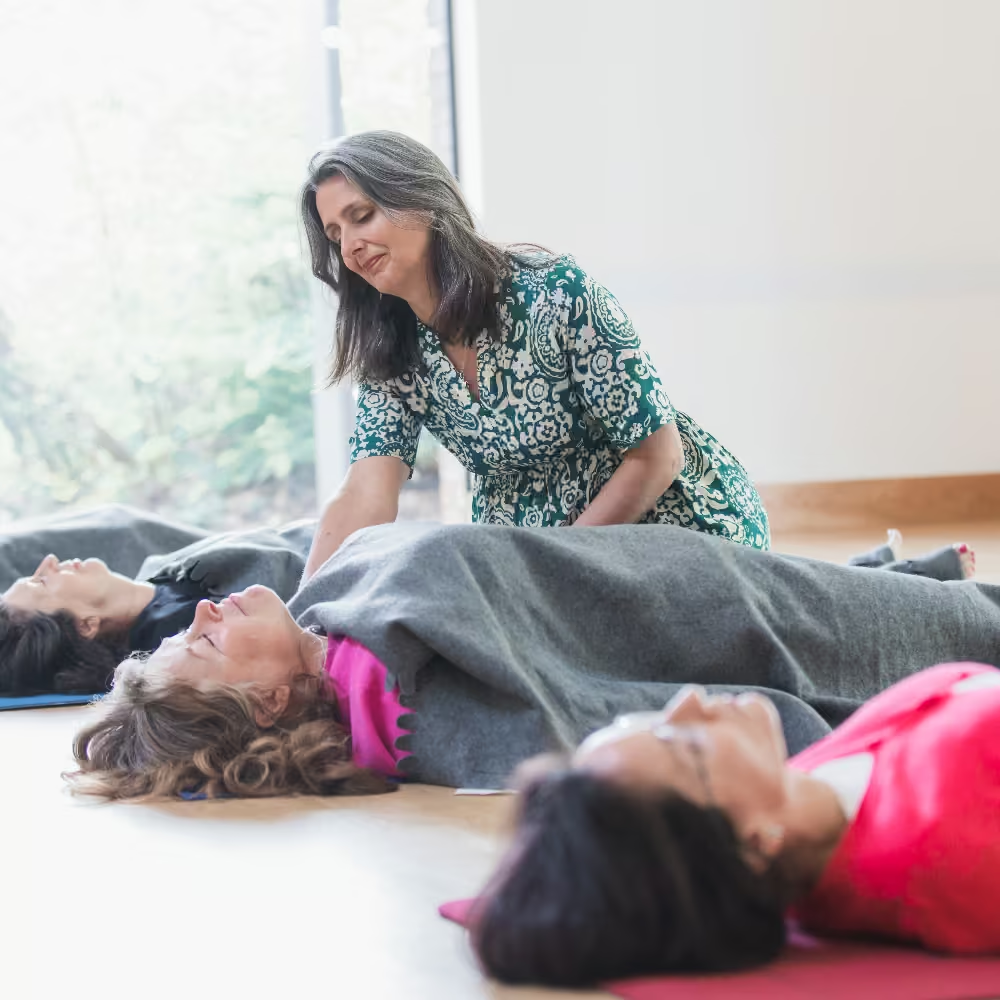
That is why I created The Circle, my weekly online space for women. Each session begins with calming breathwork and gentle movement, followed by a simple theme and practice much like the ones in this article. It is an hour to set everything else down, in the company of women who understand what it is to carry a lot. If you would like to try breathwork more deeply, you can read about my breathwork sessions, and if you would prefer to work on the roots of the loop privately, I offer one to one therapy that combines Compassionate Inquiry with breath and somatic work.
You can also simply get in touch and tell me what is going on. There is no obligation, and nothing to prepare.
The loop is not who you are. It is a pattern the body learned, and patterns can be taught something new.